Certified Arborist Consultation: Diagnosing Tree Stress and Decline
A tree rarely fails without warning. More often, it declines in slow motion, season by season, while homeowners focus on the lawn, the roof, or the driveway. By the time the canopy thins enough to raise concern, the problem may have started years earlier below grade, inside the trunk, or during a stretch of weather that seemed unremarkable at the time. That gap between cause and visible symptoms is exactly why a Certified Arborist Consultation matters.
When a tree starts to struggle, the question is not simply, “Can it be saved?” The better questions are more specific. What kind of stress is at work? Is the issue temporary or structural? Is the tree reacting to drought, soil compaction, root loss, disease, poor pruning, or age? Is there a safety risk now, or just a health issue that can be corrected? A trained arborist sorts through those possibilities with observation, history, and judgment. That process often determines whether a tree gets better, gets monitored, or needs removal before it becomes hazardous.
In practice, diagnosing tree stress is part science and part field experience. Two oaks on the same property can show the same leaf scorch for entirely different reasons. A pine with browning needles may be recovering from root disturbance, or it may be entering a decline that no amount of watering will reverse. A maple that looks “half dead” from the street may respond well to targeted Tree Pruning & Crown Shaping, mulching, and irrigation changes. Another may have a compromised root plate and belong in the category of Dangerous Tree Assessment and Removal. The skill lies in telling those situations apart before guesswork turns a manageable problem into a costly one.
What stress and decline actually look like
Tree stress is a response. Decline is a trajectory. Stress can be short term and survivable, while decline suggests the tree is losing vigor faster than it can recover. That distinction matters. A tree can tolerate a surprising amount of hardship if its root system is intact and its stored energy reserves are strong. On the other hand, a mature tree with repeated insults, compacted soil, and hidden trunk decay may continue leafing out for years while becoming structurally unreliable.
Visible symptoms often mislead property owners because they appear high in the canopy while the cause sits underground. Sparse foliage, undersized leaves, premature fall color, branch dieback, epicormic shoots on the trunk, oozing sap, fungal fruiting bodies near the base, bark cracking, and dead wood all deserve attention. None of them, by themselves, give the full answer. An arborist interprets them in context.
That context includes species, age class, site conditions, weather history, irrigation patterns, construction activity, pruning history, and pest pressure. A stressed birch in a hot reflected-heat courtyard tells one story. A stressed birch in cool, moist soil tells another. The same symptom means different things on different trees, in different places, at different times of year.
The first visit is often detective work
A good consultation usually starts with questions before tools come out. When did you first notice the change? Was there trenching, grading, or paving near the tree? Has the sprinkler coverage changed? Was fill soil added over the roots? Did someone top the canopy years ago? Has there been a recent storm? These details matter because trees respond slowly, and the trigger may predate the visible decline by one or even several growing seasons.
I have seen mature shade trees begin failing after what seemed like a minor home improvement project. A new walkway, a utility trench, or repeated equipment traffic can remove or crush enough fine roots to alter water uptake dramatically. Homeowners often say, “But we never touched the trunk.” That is the point. Most critical damage happens well beyond the trunk flare, often under the exact area people assume is safe to disturb.
The site inspection itself tends to move from broad to specific. The arborist looks at the whole crown from multiple angles, checks branch architecture, inspects bark condition, studies the root flare, and looks for signs of movement, decay, included bark, cavities, or fungal activity. Soil conditions matter too. Dry, powdery soil sends one signal. Saturated, anaerobic soil sends another. Sometimes the diagnosis is straightforward. Just as often, it is an accumulation of clues.
The most common causes behind a declining tree
No single article can cover every disorder in every species, but a handful of patterns account for many consultations.
Drought stress is common, especially in mature trees that were assumed to be self-sufficient. Established trees need less frequent watering than lawns, but they still need moisture in the root zone during extended dry periods. Too little water causes scorch, early leaf drop, and canopy thinning. Too much water can be just as harmful. Constantly wet soil depletes oxygen and encourages root decline, particularly in species that prefer well-drained conditions.
Root injury is another major factor. Grade changes, trenching, compaction from vehicles, and excessive foot traffic can reduce root function long before the canopy tells the story. On some sites, root suffocation happens because the root flare gets buried under mulch, decorative Tree service stone, or added soil. That creates chronic stress and can invite decay.
Poor pruning also contributes to long-term decline. When a tree has been topped, over-thinned, or repeatedly lion-tailed, it loses more than shape. It loses photosynthetic capacity, branch balance, and in some cases its ability to compartmentalize wounds effectively. Corrective Tree Pruning & Crown Shaping can improve structure and reduce risk, but arborists cannot simply reverse years of poor cuts.
Disease and insects complicate diagnosis because stressed trees become more vulnerable. Sometimes pests are the primary cause. Sometimes they are secondary opportunists taking advantage of a weakened host. That distinction changes the treatment plan. Spraying or treating for insects when the real issue is root loss rarely produces meaningful improvement.
Then there is simple age and species limitation. Not every tree can thrive indefinitely in every setting. Some ornamental species outlive their practical lifespan in harsh urban sites. Others were planted too close to pavement, foundations, or utilities and never had a fair chance. A candid consultation includes that reality, even when the answer is not what the client hoped to hear.
Why visible damage is not the same as risk
A declining tree is not automatically a dangerous tree, and a green tree is not automatically safe. This is where professional assessment becomes especially valuable. Structural risk depends on the likelihood of failure, the size of the part that may fail, and the target below it. A decayed limb over an empty back corner of a property is one problem. The same limb over a child’s play area, driveway, or sidewalk is another.
This is the practical side of Dangerous Tree Assessment and Removal. Arborists look at defect type, tree species, canopy load, wind exposure, root condition, and occupancy beneath the tree. Cracks, codominant stems with included bark, root plate lifting, major deadwood, basal decay, and recent soil heaving around the trunk all raise concern. So do large overextended limbs that developed after topping or poor directional pruning.
Not every risk issue calls for removal. In some cases, selective reduction pruning, weight redistribution, or Tree Cable and Bracing can extend the service life of a tree that still has good health and landscape value. Cabling is not cosmetic, and it is not a fix for every weak union. Used correctly, it can reduce the chance of structural failure in a tree with a valuable canopy and a manageable defect. Used incorrectly, it delays the obvious while increasing owner liability. Judgment is everything.
A few signs that warrant prompt evaluation
There are times when waiting for “next season” is not wise. If any of the following show up, schedule an arborist sooner rather than later:
- sudden lean or soil lifting near the base
- fresh cracks in major limbs or at branch unions
- mushrooms or conks emerging from the trunk flare or root zone
- large sections of canopy dying back within one season
- storm damage involving split stems, hanging limbs, or impact to structures
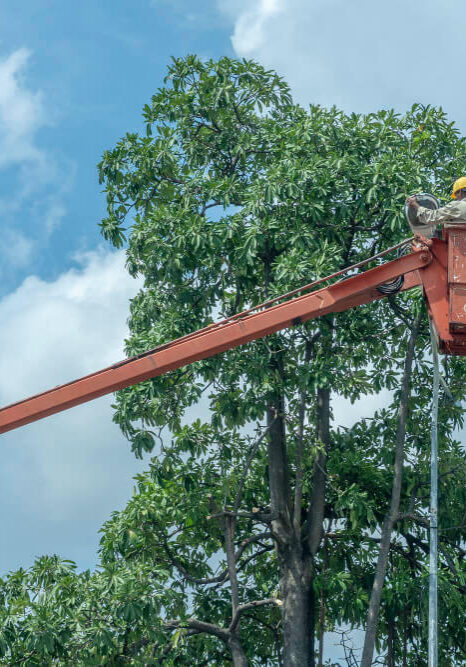
These signs do not always mean immediate failure, but they do move the tree into the category where Emergency Tree Services may become necessary if conditions worsen or another storm hits before corrective work is done.
The role of weather, timing, and cumulative stress
Trees do not respond to one bad week as much as they respond to a string of hard seasons. A dry spring followed by summer heat, then a late freeze, then an overly wet winter can push a previously stable tree into visible decline. One of the hardest parts of consultation is explaining that the current symptom may reflect last year’s stress, not this month’s weather.
This is particularly true after severe storms. Wind and saturated soil can strain roots without producing immediate failure. A tree may leaf out normally after the event and still show delayed crown dieback months later. That is one reason post-storm inspections matter, especially for large trees near homes, roads, and gathering spaces. Emergency Tree Services are for immediate hazards, but follow-up assessment is what catches the less obvious damage.
Season also affects what can be diagnosed reliably. Some foliar issues are easiest to identify when leaves are fully expanded. Branch architecture and deadwood can be easier to evaluate in dormancy. Root zone problems can become more obvious during summer heat. A strong arborist consultation accounts for timing and may recommend monitoring if the tree cannot be fully assessed on a single date.
When treatment makes sense, and when it does not
Property owners often want a simple answer: save it or remove it. In reality, there is a middle ground that deserves honest discussion. Trees can improve if the main stressor is corrected early enough and if the remaining structure is sound. That may involve irrigation adjustments, mulch replacement, decompaction, root collar excavation, pest management, soil testing, selective pruning, or support systems.
Good treatment plans are specific. “Feed the tree” is rarely enough and often not the main issue. Fertilization can help in some deficient soils, but it will not restore severed roots or stop internal decay. Likewise, heavy pruning on a stressed tree is usually counterproductive unless the goal is hazard reduction. Arborists balance the tree’s biological needs against its structural realities.
There are also cases where intervention has low odds of success. Extensive root loss, advanced decay in a critical zone, chronic failure history, severe species mismatch for the site, or a tree that has lost too much canopy over too many seasons may not recover meaningfully. In those cases, discussing Tree Removal Services is not defeatist. It is responsible. Removal can prevent property damage, reduce liability, and make room for a more suitable replacement tree.
When removal is necessary, the discussion should not stop at the trunk. Stump Removal & Grinding matters for replanting, trip hazards, pest harboring, and aesthetics. Grinding is often sufficient, though full removal may be needed depending on construction plans or species concerns. This is one of those details that is easy to overlook in the stress of losing a mature tree, but it shapes what happens next in the landscape.
Fire risk changes the conversation in certain regions
In areas with seasonal wildfire exposure, tree health and tree safety are only part of the equation. Structure proximity, ladder fuels, crown spacing, deadwood, and species flammability all influence risk. A declining conifer close to a home is not just a horticultural problem. It may become a fire behavior problem.
That is where Wildfire Mitigation Tree Services enter the consultation. The goal is not indiscriminate clearing. It is strategic reduction of fuel continuity while preserving the healthiest, most appropriate trees. Dead limbs, suppressed understory trees, dense spacing near structures, and accumulated debris can all increase ember ignition potential and fire intensity. In these settings, arborists often work at the intersection of plant health, defensible space, and local code requirements.
A mature tree with some stress Tree Pruning & Crown Shaping symptoms may still be worth retaining if it is structurally stable and properly maintained. Another tree of the same species, closer to the home and loaded with dead material, may need removal even if it is still partially green. That kind of decision is hard to make from a distance or by rule of thumb. It benefits from on-site professional judgment.
What homeowners can do before the arborist arrives
A consultation goes better when the property owner can provide a little history and a few observations. You do not need technical language. Clear notes are enough.
- note when the symptoms first appeared and whether they are spreading
- mention recent construction, trenching, paving, or grade changes
- describe watering habits, drainage issues, or standing water
- gather photos from previous seasons if the tree looked fuller or healthier
- identify any nearby targets such as structures, parked cars, or play areas
That short background often speeds diagnosis because trees rarely decline in a vacuum. There is usually a story in the site history.
The value of a second opinion in borderline cases
Some trees occupy a gray zone. They are valuable enough to fight for, expensive enough to remove, and risky enough that uncertainty feels uncomfortable. Large legacy trees over homes often fall into this category. If one arborist recommends removal and another believes the tree can be retained with pruning, cabling, or monitoring, a second consultation is sensible.
That does not mean shopping for the answer you want. It means clarifying the basis for the recommendation. Is the concern health, structure, or target occupancy? Is the defect active or stable? What would change the recommendation in six months or one year? Are there measurable thresholds for action, such as crack progression, canopy loss percentage, or root plate movement? The strongest opinions in arboriculture are usually the ones that can explain their uncertainty clearly.
Realistic expectations after diagnosis
People often assume that once a tree problem is identified, recovery should be quick. Trees do not work that way. A stressed mature tree may need two or three growing seasons to show meaningful improvement after the root zone is corrected or pruning is completed. Some symptoms, such as dead branch tips or lost crown density, will not disappear immediately. The best sign of progress is often subtle: normal leaf size returning, dieback slowing, shoot growth improving, or the canopy stabilizing instead of continuing to thin.
Monitoring matters. A quality Certified Arborist Consultation should lead to a plan, not just a verdict. That plan may include reinspection after summer heat, follow-up after storms, or a pruning cycle every few years. It may also include deciding not to intervene aggressively and instead tracking the tree’s response. Sometimes restraint is the smartest professional move.
Trees are long-lived organisms, but not infinitely forgiving
Home landscapes ask a lot of trees. We compact their root zones, change drainage, prune for clearance, expect shade fast, and worry only when they start to look rough. Most trees tolerate more than they should have to. The ones that stay healthy usually have two things in common: appropriate species selection and timely attention before minor stress becomes chronic decline.
That is the real purpose of consultation. Not just to identify what is wrong, but to frame what is still possible. Sometimes that means preserving a valuable tree with targeted care. Sometimes it means reducing risk through Tree Cable and Bracing or thoughtful Tree Pruning & Crown Shaping. Sometimes it means acting decisively with Tree Removal Services, followed by Stump Removal & Grinding and a better replanting plan. And sometimes, especially after a storm or in high-target areas, it means recognizing when Emergency Tree Services or Dangerous Tree Assessment and Removal cannot wait.
A tree does not need to be perfect to be worth keeping. It does need to be understood. That is what a skilled arborist brings to the property: not just a diagnosis, but perspective, prioritization, and a clear-eyed read on whether the tree can continue to stand safely and well in the place where it was planted.
Name: Ace Tree Services Ltd.
Address: 4656 Wallace Hill Rd, Kelowna, BC V1W 4C2, Canada
Phone: 250-212-9593
Website: https://acetree.ca/
Email: [email protected]
Hours:
Sunday: Closed
Monday: 7:00 AM–5:00 PM
Tuesday: 7:00 AM–5:00 PM
Wednesday: 7:00 AM–5:00 PM
Thursday: 7:00 AM–5:00 PM
Friday: 7:00 AM–5:00 PM
Saturday: 7:00 AM–5:00 PM
Time zone: Pacific Time
Open-location code / Plus code: RHF8+8G Kelowna, British Columbia, Canada
Map/listing URL: https://www.google.com/maps/search/?api=1&query=Google&query_place_id=ChIJxRVIBx2LfVMRNRSkp6-IC0U
Embed iframe:
Socials:
https://www.facebook.com/p/Ace-Tree-Services-61585901931447/
Ace Tree Services Ltd. provides professional tree care from its Kelowna location on Wallace Hill Road.
The official website lists tree removal, stump removal and grinding, tree pruning and crown shaping, emergency tree services, certified arborist consultation, dangerous tree assessment and removal, tree cabling and bracing, and wildfire mitigation.
Ace Tree Services serves homeowners, businesses, and property owners in Kelowna and throughout the Okanagan Valley.
The company’s official site highlights ISA Certified Arborist support, local Okanagan experience, and fully insured tree service work.
Customers can contact Ace Tree Services for planned tree maintenance, high-risk removals, storm-related tree concerns, pruning, stump grinding, and arborist consultation needs.
The supplied public listing address is 4656 Wallace Hill Rd, Kelowna, BC V1W 4C2, near rural and residential service areas in southeast Kelowna.
For tree services in Kelowna and the Okanagan, call 250-212-9593, email [email protected], or visit https://acetree.ca/
The public map listing uses plus code RHF8+8G Kelowna, British Columbia, Canada and can help customers find Ace Tree Services Ltd. near Wallace Hill Road.
Popular Questions About Ace Tree Services Ltd.
What does Ace Tree Services Ltd. do?
Ace Tree Services Ltd. provides tree removal, stump removal and grinding, tree pruning and crown shaping, emergency tree service, certified arborist consultation, dangerous tree assessment and removal, tree cabling and bracing, and wildfire mitigation.
Where is Ace Tree Services Ltd. located?
Ace Tree Services Ltd. is listed at 4656 Wallace Hill Rd, Kelowna, BC V1W 4C2, Canada.
What phone number should customers call?
Customers can call Ace Tree Services Ltd. at 250-212-9593.
What is the email address for Ace Tree Services Ltd.?
The supplied email address is [email protected].
What are Ace Tree Services Ltd.’s hours?
The supplied listing hours show Monday through Saturday from 7:00 AM to 5:00 PM, with Sunday closed, Pacific Time. The official website lists 7:00 AM to 5:00 PM, Monday through Friday, so customers should confirm Saturday availability before booking.
Does Ace Tree Services Ltd. provide emergency tree service?
Yes. The official website lists emergency tree services, including emergency tree removal, dangerous tree assessment, emergency stabilization, and limb or branch cleanup.
Does Ace Tree Services Ltd. offer arborist consultations?
Yes. The official services page lists certified arborist consultation as one of the company’s Okanagan tree services.
Does Ace Tree Services Ltd. provide stump grinding?
Yes. The official services page lists stump removal and grinding as a service.
What areas does Ace Tree Services Ltd. serve?
The official website states that Ace Tree Services serves Kelowna and the Okanagan Valley.
How do I contact Ace Tree Services Ltd.?
Call 250-212-9593, email [email protected], visit https://acetree.ca/, or use the listed social profile: Facebook.
Landmarks Near Kelowna, BC
Wallace Hill Road: The road listed for Ace Tree Services Ltd. and a practical reference point for the company’s Kelowna location.
East Kelowna: A nearby rural and residential area where tree maintenance, pruning, removals, and wildfire mitigation can be important for property owners.
Myra-Bellevue Provincial Park: A major outdoor landmark southeast of Kelowna and a useful reference for the surrounding hillside and forested areas.
Gallagher’s Canyon: A nearby Kelowna community with residential properties, mature trees, and landscape maintenance needs.
Kettle Valley: A southeast Kelowna neighborhood with homes, parks, and landscaped properties.
Mission Creek Greenway: A well-known natural corridor in Kelowna and a local reference point for tree-lined recreation areas.
Orchard Park Shopping Centre: A major Kelowna retail landmark and citywide reference point.
Downtown Kelowna: A central business and residential district within Ace Tree Services’ broader Kelowna service area.
Okanagan Lake: A major regional landmark running through Kelowna and the surrounding Okanagan Valley.
Mission Creek Regional Park: A recognizable Kelowna park and natural landmark with extensive trees and trails.
Rutland: A large Kelowna community with residential and commercial properties that may need tree service support.
Glenmore: A Kelowna neighborhood with homes, parks, and established trees.
Lower Mission: A residential and lake-adjacent Kelowna area where pruning, tree health, and property safety can matter for homeowners.
Kelowna International Airport: A major transportation landmark north of central Kelowna.
West Kelowna: A nearby Okanagan community across the lake and a practical regional service reference.
For tree removal, stump grinding, pruning, crown shaping, emergency tree service, arborist consultation, dangerous tree assessment, cabling and bracing, or wildfire mitigation near these Kelowna and Okanagan landmarks, contact Ace Tree Services Ltd. at 250-212-9593, email [email protected], or visit https://acetree.ca/